Effort at the Wrong Level
In March, a central bank on another continent raises its interest rate. A trader in Kumasi does not read the announcement. An engineer in Nairobi does not either. Neither does a shop owner in Aba.
By June, all three have paid for it.
When money earns more sitting safely abroad, it leaves markets like ours. Our governments borrow at worse rates, our currencies weaken, imports cost more, and our central banks respond by holding rates high. Banks then lend less and charge more for what they do lend.
So the engineer's employer cannot close its funding round, hiring freezes, and his salary buys less in December than in January. The trader's goods cost more, her customers have less, and her supplier now wants cash upfront instead of thirty days, which quietly doubles the money she must hold to trade at the same size.
None of them made a mistake. None could have prevented it by working harder at their own trade. The decision that shaped their year was taken at a level they never look at, by people who have never heard of them.
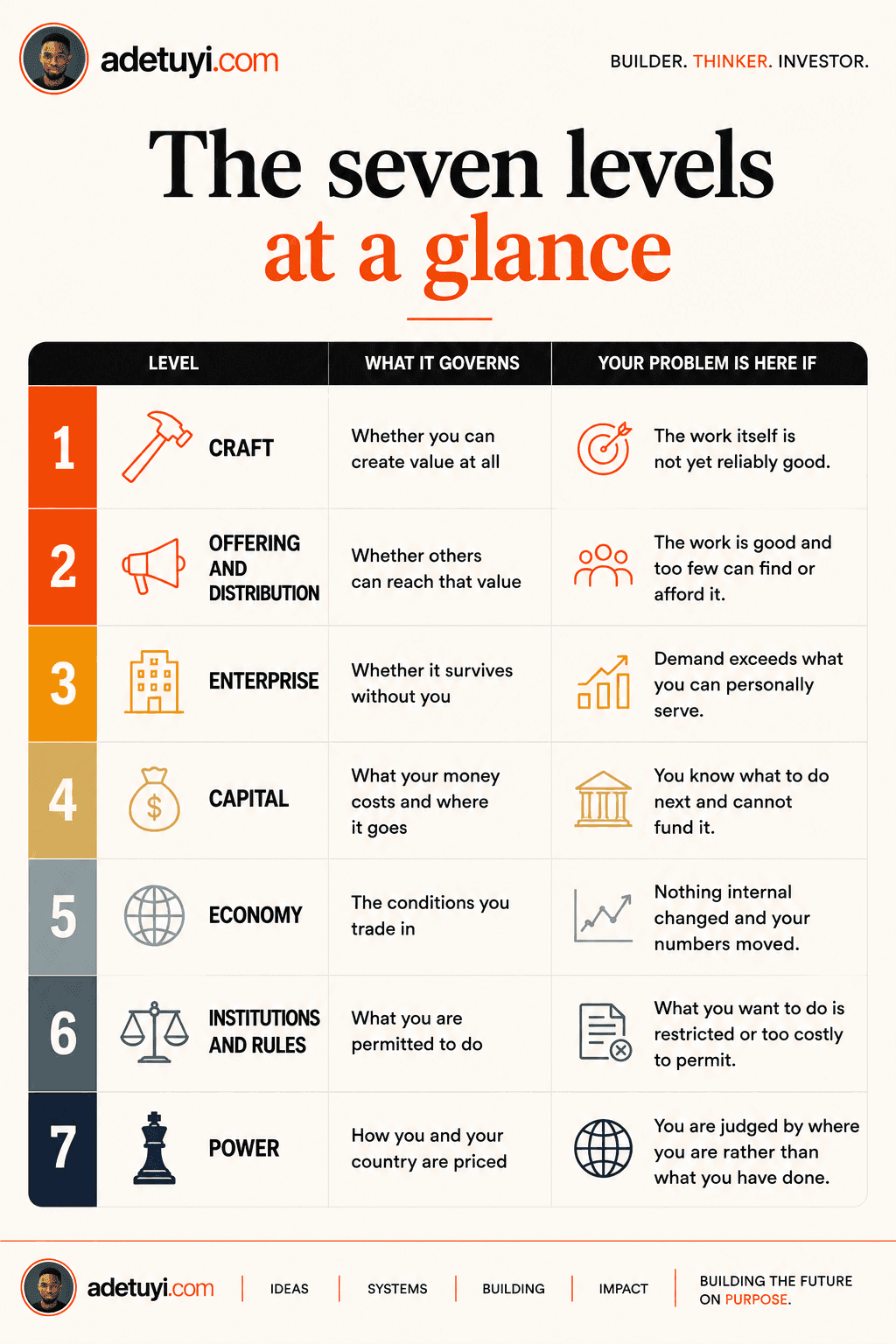
Your income is shaped at seven levels at once, but at any given moment one of them is binding, and for most people it is not the one they are working on. Skill is the first. The price of money is the fifth. The rules of your industry are the sixth. A problem at the fifth cannot be solved by working harder at the first, and a great deal of honest effort across our economies goes into that exact attempt.
2. Offering and distribution. Packaging it so others can reach it.
3. Enterprise. Organising it beyond yourself.
4. Capital. Financing and allocating it.
5. Economy. The conditions you work within.
6. Institutions and rules. Who sets the rules and enforces them.
7. Power. Who shapes the system, here and beyond our borders.
This is not a career ladder. You do not leave one level to reach the next. It is a question of distance.
Distance matters for a reason worth holding from the start. A constraint sitting higher up is not necessarily more binding. It is less responsive to you. Those are different properties, and confusing them is what makes people either give up too early or push for years against something that was never going to move.
It is also not permission. Naming a higher level does not excuse an unresolved lower one. You cannot have a distribution problem until you have made something worth distributing.
To keep it concrete I will use one example. Between 2019 and 2022 I built an agent banking network, which meant a great deal of time beside plastic tables on Nigerian streets. An umbrella, a POS terminal, a cash box, a notebook with a biro tied to it. A woman sits behind it from six in the morning and serves two hundred customers on a good day.
I will call her Grace. The same table stands in Nairobi and Kumasi, and she has the same name in all three places.
1. Craft
Grace counts cash faster than most people can follow. She identifies a false note by touch. She knows which customers return and which will argue over a hundred naira. Each evening she reconciles terminal against cash box against notebook, and where it does not balance the difference comes from her own money.
None of it is written down. If she travelled tomorrow nobody could run her table properly, because the knowledge sits in her hands rather than in a document. Economists call this human capital, value stored inside a person rather than in a machine. The same holds for a surgeon's judgement, a mechanic's ear and a farmer's sense of when the rain will come.
The work here is repetition and honest feedback. Nothing substitutes for it.
Be blunt about the reverse, because the rest of this can be misused. This is the only level you control completely and the only one where no external explanation is available to you. Someone who has not yet learned to do anything particularly well is not being held back by interest rates, regulation or geopolitics. Their constraint sits here, and of the seven it is the most solvable.
That is the good news at this level. Above it, other people get a vote.
2. Offering and distribution
Skill explains why Grace survives. To explain what she earns you have to ask what she is actually selling, and it is not cash.
She is a bank branch. She opens before the bank opens and closes after it closes. She is four minutes away rather than forty, and she does not demand three documents before releasing your own money to you. What she sells is nearness, hours, speed and trust. Kenya reached this conclusion earlier than anyone, with mobile money accounts there now above 53 million.
But a distribution advantage is not permanent, and Kenya shows that too. The commission pool paid to M-Pesa agents has been roughly flat for three years at around 37 billion shillings. The agent count has not. It rose from about 173,000 in 2020 to 333,011 by March 2026, and average annual earnings per agent duly fell from 144,355 shillings in 2024 to 112,244 in 2026, roughly 9,353 a month before rent and wages.
Not one of those agents became worse at the job. Proximity stops being scarce once three others are on the same street.
The work here is packaging, pricing, placement and proof, then finding the next advantage before this one is copied. Not more skill. Additional skill here usually avoids a harder question.
3. Enterprise
One kiosk is a business. A hundred thousand is a different problem, and most people meet that problem long before they run anything that large.
The consultant who cannot take a holiday. The clinic where patients will only see one doctor. The tailor whose customers trust her hands and nobody else's, who cannot grow past what two hands can sew. The business is real, demand exists, and the value has not been separated from the person producing it.
The network I worked on opened with about a thousand agents in September 2019. Two years later it was reported to be processing around four billion dollars a month. The thousandth agent was expensive to add. The hundred thousandth was nearly free. That gap is operating leverage, and it explains both why these businesses are punishing early and why they are hard to catch late.
What made it work was not the application. It was that when Grace's terminal failed, somebody she could name answered the phone.
The work here is written process, delegation and hiring. Longer hours make this worse, because they postpone the moment the organisation is forced to work without you.
4. Capital
Grace must hold money before she can earn anything. If she runs dry at eleven in the morning she is closed until she restocks, and customers who walk to the next kiosk may not return. Her income is limited by the size of her cash holding, not by her effort.
Working capital is the money a business must hold simply in order to trade. Cost of capital is the price it pays for that money.
The distinction that matters at this level is between the money terms you can negotiate and the prices you cannot. Grace can choose where her float comes from. Savings, a cooperative, a supplier's credit, an advance from the company behind her terminal. She can negotiate tenor and security. She can shorten the gap between paying out and being paid. Those are real decisions and they compound.
Take two agents with identical skill, identical hours and identical location, facing the identical national interest rate. One funds her float from savings. The other borrows monthly at whatever the cooperative charges. Within a year their circumstances are not comparable, and nothing about their ability or their environment explains the gap. Only the terms do.
A business earning a fifteen per cent margin and funding itself at thirty is not a struggling business. It is a business working for its lender.
The work here is cheaper or better structured funding, and shortening your cash cycle. Selling harder into an expensive float only enlarges the problem.
5. Economy
Grace can choose her lender. She cannot choose the rate the whole market is priced off. That is the line between this level and the last one. Capital is the part of money you negotiate, the economy is the part that is quoted to you.
Nigeria's policy rate was cut to 26.5 per cent earlier this year and held there, with commercial lending well above it. Every agent in the country faces that number. None of them negotiated it.
The same is true of everything else at this level. In early 2023, when the naira was redesigned and cash disappeared, Grace became the most important person on her street. Her competence had not changed. Queues that formed at bank doors formed at her table, and her fees rose because scarcity permitted it. Fuel prices determine what her customers have left. A weaker currency raises the cost of the terminal she is saving towards. And her hundred naira fee, unchanged for two years, has been shrinking the whole time. Nigerian headline inflation stood at 15.43 per cent in July 2026. She did not reduce her price. Her price reduced itself.
The work here is pricing that adjusts, costs that can be cut quickly, and less exposure to what you cannot control. This is also where people reach for a moral explanation of who is succeeding. Frequently the honest explanation is conditions.
6. Institutions and rules
Conditions arrive without an author. Rules have one.
Nigeria has roughly two million banking agents and 8.36 million registered POS terminals, moving 10.51 trillion naira in the first quarter of 2025 alone. In October 2025 the central bank ruled that every one of those agents must become exclusive to a single principal, with a compliance deadline of 1 April 2026. Many had deliberately spread across two or three networks so that one outage would not close them for the day. That protection was withdrawn by a document none of them were consulted on, and two million people restructured their businesses inside six months.
Ghana ran the clearest version of the same thing. A levy on electronic transactions, introduced in 2022 to raise revenue, ended up charging the very mechanism that had brought millions of Ghanaians into the financial system. Its revenue projection proved so optimistic that the government cut the target by more than ninety per cent within the year, and the levy was repealed in 2025.
Regulation first appears as compliance. Examined properly it is market architecture. Licensing decides who may compete at all, and identity requirements decide who can be served in the first place. Policy is only what is written; institutions determine whether what is written is administered predictably. Two countries can adopt identical laws and produce entirely different economies.
The work here is obtaining a licence, partnering with someone who holds one, or engaging seriously with the people who write the rule. Persistence against a regulation is not resilience. It is expense.
7. Power
Rules are written by people who can be named. Above them sits the question of what those people are constrained by.
Grace's terminal was manufactured abroad and priced in dollars. The capital that funded her float was raised in London or Nairobi or Washington, by people who discounted the entire opportunity before reading a single page concerning her.
The size of that discount is measurable. African sovereigns paid around 9 per cent on dollar bonds in 2024, against 6.5 per cent for Latin America and 4.7 per cent for emerging Asia. Some of that is fundamentals, and it should be. Default history is real, so is currency convertibility, so is political risk. But the OECD found the gap could not be explained by income levels alone, and once debt ratios, growth and inflation are controlled for, African countries still pay roughly 1.5 percentage points more than comparable peers elsewhere. The IMF puts the excess over similarly rated countries at around half a point, widening under stress.
The UNDP costed the portion it attributes to rating subjectivity rather than to fundamentals at about 75 billion dollars a year, split between 28 billion in excess interest and 46 billion in capital investors simply declined to deploy. Set against bilateral aid to Sub-Saharan Africa of 29.2 billion, that excess alone takes back more than twice what the aid brings in.
What produces it is not malice. African issuers make up under a tenth of emerging market hard currency bonds, so analyst coverage is thin, and where quantitative evidence runs out, qualitative judgement fills the gap. During the pandemic 60 per cent of rated African sovereigns were downgraded, against roughly a third globally. That is what a coverage gap looks like in a downgrade cycle.
The same mechanism reaches Grace. It was not that agents repay poorly. In the network I ran, their repayment behaviour was frequently better than that of salaried borrowers. It was that no verified identity existed that a lender recognised, no transaction history it trusted, no record it could check. This is the cost of being illegible, to borrow James Scott's word for the problem, and the mechanism beneath it is Akerlof's. Where a buyer cannot separate the good from the bad, they refuse the good price to both. Honest participants subsidise dishonest ones, and the most reliable borrowers pay most relative to their actual risk.
That portion of the premium is not a judgement about Africa. It is a judgement about the available information, and information can be built.
The shift is already visible in the numbers. Nigerians abroad sent home 21.8 billion dollars in 2025, and what is changing is not the total so much as the share arriving through channels that leave a record, with formal transfers through licensed operators rising 45 per cent in the first quarter of 2026. The money was always there. Some of it is only now becoming legible.
The work here is producing the record. Audited accounts, verified identity, clean transaction history, credible partners, third party confirmation. A competence problem is solved by improving. A legibility problem is solved by building the evidence, and the second is entirely achievable.
That is most of the reason I now spend my working life on identity and compliance infrastructure. Not because verification is interesting in itself, but because until Grace is readable to the system, she pays for its ignorance.
Which way it runs
Value travels downward. Power sets the rules, rules set the conditions, conditions set the terms on which anyone can raise money, those terms set what enterprises can build, what enterprises build sets which offerings exist, and offerings set what craft is worth.
That last link is the one to sit with. A skill is only valuable where a structure is willing to pay for it. The same engineer is worth very different amounts in two countries, and it is not because the engineering differs.
But the chain is not one way, and my own example is the proof. Agent networks were built at the level of enterprise, and they forced both the conditions and the rules above them to change. Kenya's regulator adapted to mobile money rather than the reverse. Nigeria's 2025 circular exists precisely because something at the level of enterprise had grown large enough that the level of institutions had to answer it.
Value flows downward. Pressure flows upward. That is the strongest argument available for building anything at all.
Read only downward and you get fatalism, where nothing is your responsibility. Read only upward and you get moralism, where every outcome is deserved. Both are true at once, and neither alone describes how an economy behaves.
Finding your own level
I have watched the error run both ways. Someone works punishingly at craft when their limitation belongs to capital. Someone raises money for a business that never resolved offering. Someone builds carefully against a rule that makes the model unlawful.
The second version is the more comfortable one. The higher the level you blame, the less you can personally do about it, which is precisely what makes blaming it restful. Interest rates, regulation and geopolitics are genuine constraints. They are also the most convenient place to file a problem you would rather not look at.
Which is the rule, and it is worth stating exactly, because the loose version of it is old. Set your house in order before you criticise the world is Jordan Peterson's sixth rule, and long before him Maslow argued that lower needs must be met before higher ones become operative. The version I want is narrower.
You may act at any level at any time. You may not file your constraint above the level that is actually binding.
That distinction matters because my own example breaks the loose version. The network I described was engaging regulators and raising capital abroad while its craft and organisation were still unsettled. Every serious business operates at all seven levels from the first day, and it should.
Engaging a regulator early is work. Raising money early is work. Neither is forbidden. What is forbidden is recording your problem at level six when it is sitting at level two, because a diagnosis filed too high stops you looking down. That narrower version is the part of this I have not found stated anywhere else, and it is what keeps the rule from collapsing into advice about knowing your place.
There is a test for this, and it is a counterfactual. If the thing you are blaming vanished tomorrow, could you actually move?
Give Grace a policy rate of zero and she is still capped by a hundred naira fee on a street with three other agents on it. The rate was real. It was not what was holding her. Run the same question on whatever you have been blaming, honestly, and if removing it would not free you, then it was not your binding constraint and something beneath it is.
That question is Goldratt's, from the theory of constraints, and it is the whole method. Everything above it is a map of the places to point it.
Effort applied at the wrong level closely resembles progress. It produces very little.
Work with me
If something in this piece resonated, that is usually where the conversation starts.
Written by
Tolu Adetuyi