The Closed-Loop Trust System
Most fintech compliance systems are built backwards. They start with verification, then add monitoring, then patch fraud response when something breaks. But in reality, financial trust does not work in steps. It works as a system.
When you treat compliance as a checklist, you inevitably leave gaps. Bad actors do not exploit the rules. They exploit the spaces between the rules. If your verification system does not talk to your transaction monitoring, and your transaction monitoring does not talk to your escalation workflows, you are not managing risk. You are just reacting to it.
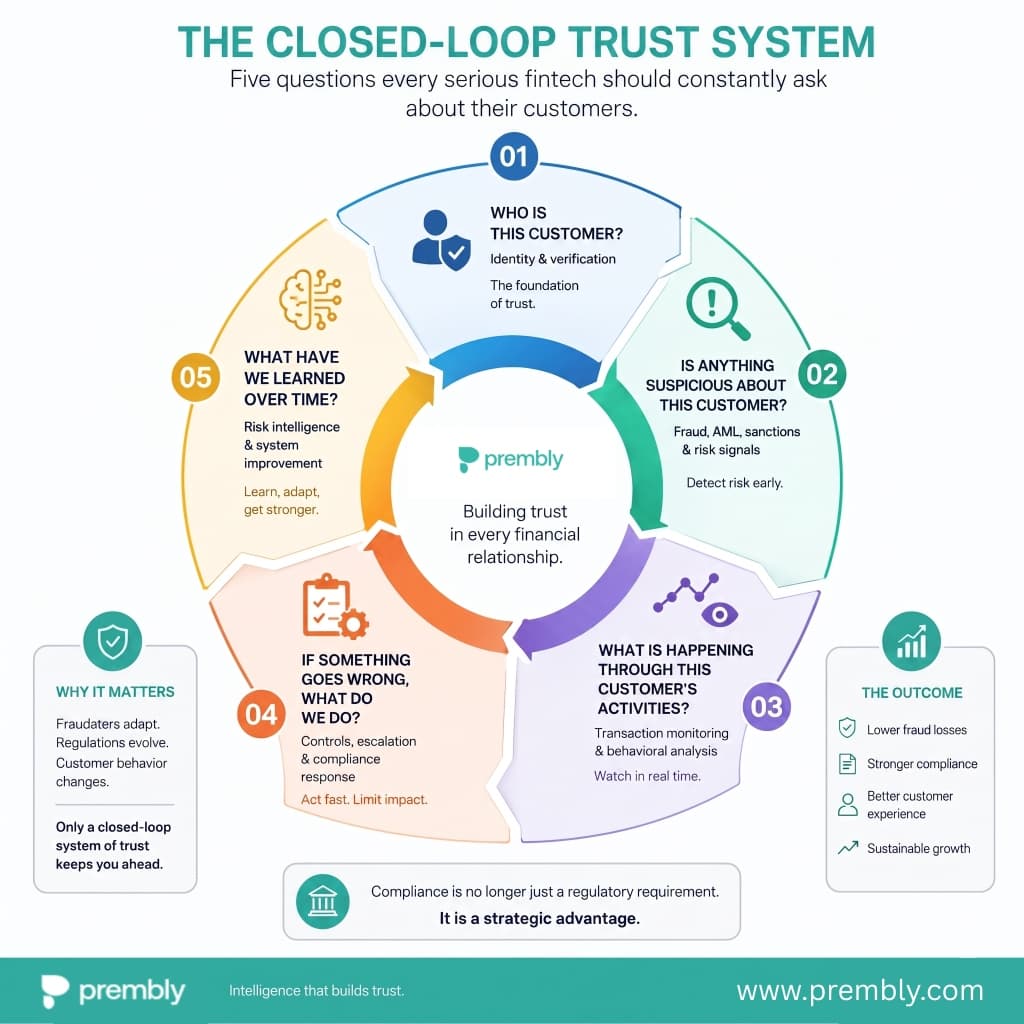
The real question every serious fintech should be asking is simple. What do we need to continuously understand about this customer to stay ahead of risk? That breaks down into five ongoing questions.
Who is this customer?
Identity and verification form the absolute foundation of trust. Without a definitive answer to who is accessing your platform, everything built on top of that relationship is structurally compromised.
Is anything suspicious about this customer?
This is early risk detection across fraud, AML, and sanctions signals. It is not enough to verify an identity once. The environment changes, watchlists update, and new patterns emerge. Detection must begin the moment the relationship starts.
What is happening through this customer's activities?
Behavioral and transaction level monitoring must happen in real time. Static profiles are useless against dynamic threats. Understanding normal behavior is the only reliable way to flag anomalous activity.
If something goes wrong, what do we do?
Detection without action is just expensive surveillance. You need clear decisioning, escalation, case management, and enforcement workflows. When a signal trips, the system must either stop the threat automatically or route it to the right human instantly.
What have we learned over time?
Analytics and feedback loops are what turn a static defense into an adapting intelligence. Every incident, false positive, and verified threat must feed back into the system to improve the next decision.
This is not a checklist. It is a closed-loop system of trust.
At Prembly, this is how we think about modern compliance infrastructure. Not as isolated tools, but as connected layers that continuously identify, detect, respond, and learn.
Because in fast growing markets like emerging economies, fraud does not wait for periodic reviews. It adapts in real time. The systems that survive are not the ones that verify customers the fastest. They are the ones that understand customers continuously.
Read next
The Other Side of the Transaction
Why legitimate customers can become invisible across borders, and how local trust infrastructure can connect markets without exporting their records.
6 min read→When a Payment Becomes Evidence
For over a decade, the NIBSS Instant Payments rail moved money fast and asked no questions. The National Payment Stack ends that era. Every transaction now carries structured proof of who sent it, why, and what it settles. That turns every payment into a compliance record at the point of origination.
7 min read→Work with me
If something in this piece resonated, that is usually where the conversation starts.
Written by
Tolu Adetuyi