The Framework of Agency
When you are highly analytical, the biggest friction to taking action is the sheer weight of the first step. If a project feels too heavy to start, it is almost always because the scope of that first step is wrong. You are trying to build the engine before you have even verified that the fuel line works.
To bridge the gap between theoretical optimism and a live operational loop, the best builders rely on specific tactical frameworks designed to minimize the cost of momentum. I did not invent these methodologies. They are battle tested tools borrowed from software engineering and top tier operators. But adopting them fundamentally changed how I execute, and they are exactly what I use today to push projects out of the planning phase.
Here are three of the most effective frameworks I have adopted.
1. The Tracer Bullet Methodology
Borrowed from pragmatic engineering, a tracer bullet is an ultra lean skeleton of a system. Instead of building each component perfectly in isolation, you build a thin, unpolished pipe that connects every single stage of the process from trigger to final delivery. Building in isolation creates massive execution anxiety, but the tracer bullet forces you to focus only on the flow.
The Principle: It does not need to be scalable, pretty, or automated. It just needs to prove that data, capital, or goods can move from Point A to Point Z without the whole structure collapsing.
An Example: If you are building a B2B cross border settlement platform, a tracer bullet is not an automated API with a slick dashboard. It is a manual Google Form that collects client info, a manual bank transfer you make yourself, and a WhatsApp message notifying the supplier. It is unscalable, but it proves the operational rails exist.
2. The Time Boxed Spike
A Spike is a tool used by systems designers to de-risk the unknown. When an individual gets stuck in the optimism phase, it is usually because they are staring at a massive, ambiguous block of work or technical uncertainty.
A Spike isolates one single assumption and attacks it within a strict, non negotiable time limit. I usually set this to two or four hours.
The Principle: The goal of a spike is not to create a permanent asset. It is to gather information through motion. You give yourself permission to write ugly code, make sloppy drafts, or pick up the phone and cold call an expert.
The Guardrail: Once the timer hits zero, you must stop. You will find that 90% of the ambiguity vanishes the moment you get dirty in the details for just two hours.
3. The Spike to Scale Execution Loop
For ongoing operations, you can institutionalize this behavior into a continuous four stage feedback loop. This is the exact framework I use to force my brain to treat action as a mechanism for learning rather than a high stakes test of intellect.
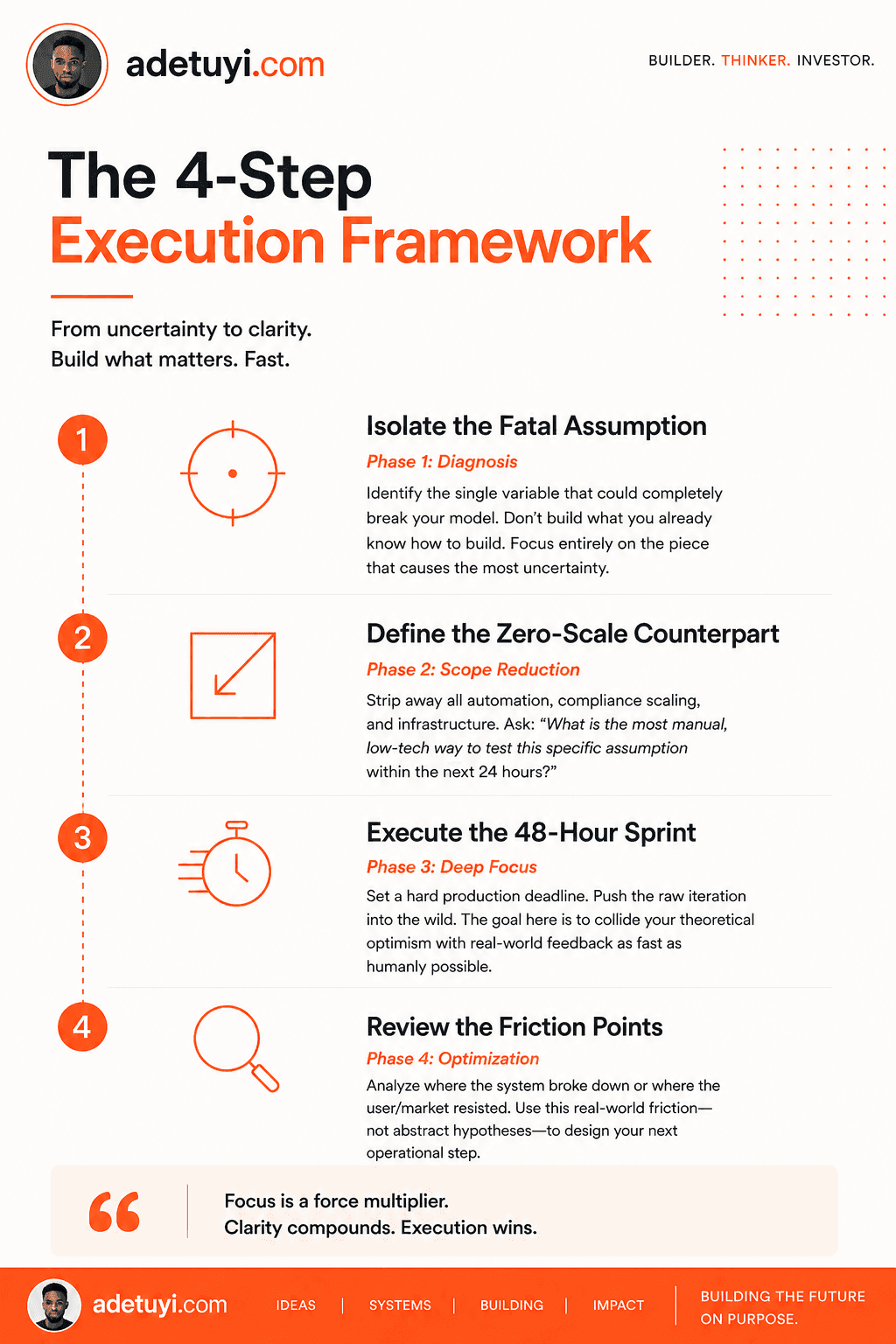
Phase 1: Isolate the Fatal Assumption
Identify the single variable that could completely break your model. Do not build what you already know how to build. Focus entirely on the piece that causes the most uncertainty.
Phase 2: Define the Zero Scale Counterpart
Strip away all automation, compliance scaling, and infrastructure. Ask what is the most manual, low tech way to test this specific assumption within the next 24 hours.
Phase 3: Execute the 48 Hour Sprint
Set a hard production deadline. Push the raw iteration into the wild. The goal here is to collide your theoretical optimism with real world feedback as fast as humanly possible.
Phase 4: Review the Friction Points
Analyze where the system broke down or where the market resisted. Use this real world friction to design your next operational step. Never rely on abstract hypotheses when you can use real data.
The 70% Rule of Certainty
A great guiding metric for this transition is the 70% Rule popularized by top tier operators. If you wait until you have 90% of the information to act, you are moving too slowly. Your competitors will out learn you.
If you are at 70% certainty, your strategy is sound enough. Any information gained by waiting for the remaining 30% is vastly inferior to the data you will collect by simply launching a tracer bullet and watching where it lands.
Action produces information that thinking simply cannot mirror. Turn the key. If the blocker is not methodological but psychological — a loop that survives good frameworks — The 5 Mindsets of Real Progress speaks to that directly.
Read next
Everything Made in One Shot Has a Look
The poster with the gradient nobody chose. The deck where every slide has the same rhythm and none of them has a point. It looks finished. Nobody finished it. Two rules fix that, and neither one can put you in the work. AI did not invent the problem, it made it free.
4 min read→Effort at the Wrong Level, Part Three
Above the rules sits the question of who gets to write them, and what a country is charged before anyone looks at its businesses. The seventh level, how pressure still travels upward against it, and the test for finding your own.
5 min read→Work with me
If something in this piece resonated, that is usually where the conversation starts.
Written by
Tolu Adetuyi