Be Resilient About the Mission, Curious About the Method
Spend enough time around the startup ecosystem and you will hear a fairly consistent formula for success. Master computer science. Sharpen your business acumen. Build operational excellence. Accumulate enough market wisdom to stay a few steps ahead of everyone else.
I am grateful for every bit of that. The technical depth, the academic training, the strategic frameworks, the years of learning how organisations actually work. They are real, and anyone building in a complex environment needs them.
But those are engine parts. They are not what keeps the machine moving when the road disappears.
When I look back, from student projects to engineering, product, growth and building companies, I find the same two things underneath every breakthrough that mattered. Not intellect. Not strategy. Two quieter traits that arrived before the credentials did.
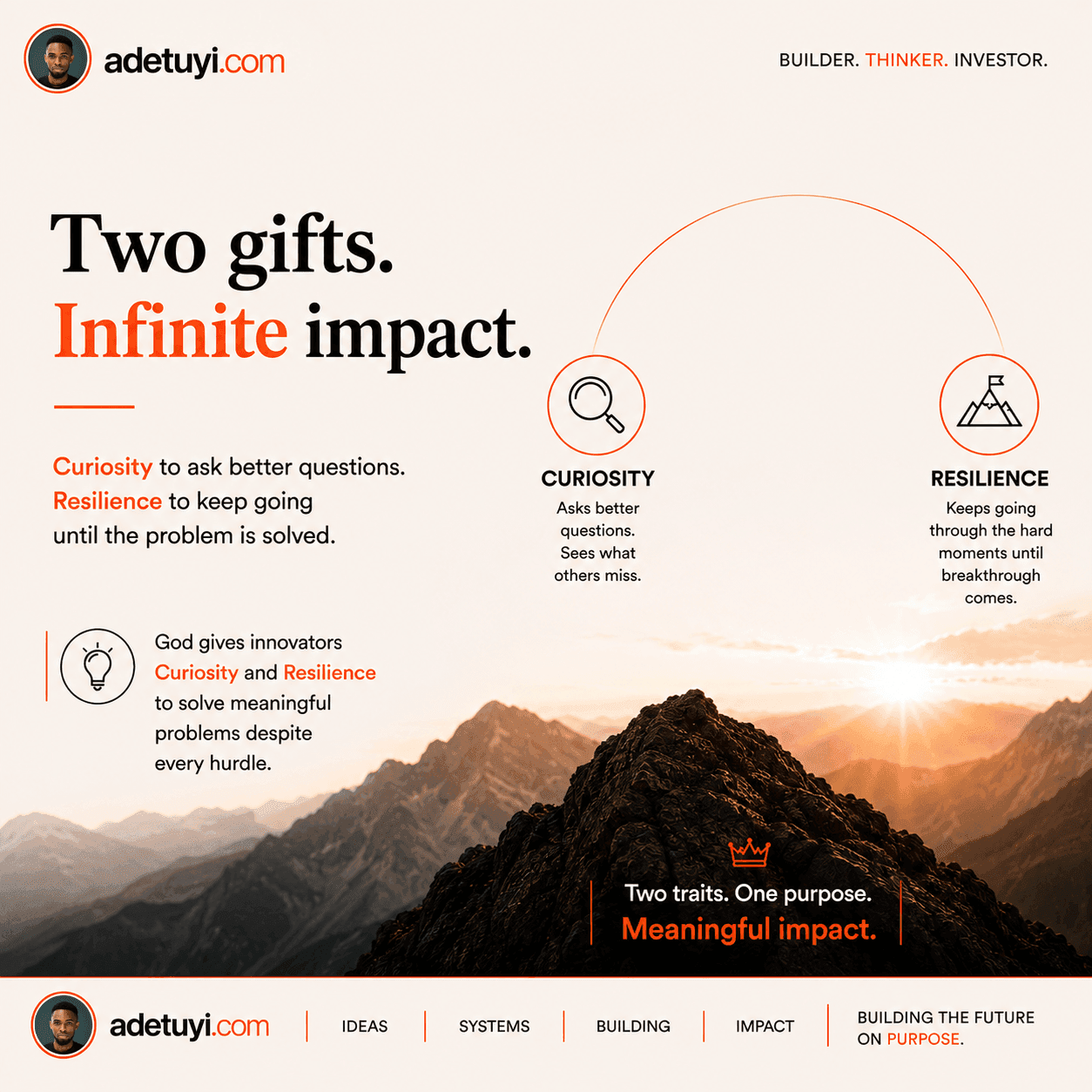
Curiosity and resilience.
I consider both gifts from God. I did not manufacture the first impulse to ask or the willingness to continue after failure, but a gift still has to be cultivated. They are not the only ingredients for success. They are the ones I return to when the path is unclear.
Curiosity asks what else this could become. Resilience says we keep going until we find out.
Curiosity came before competence
Long before I had a title, a track record, or access to anything resembling resources, I was curious.
As a student, I was not satisfied with learning computer science in a classroom. I wanted to know what technology could actually do out there, in the ordinary friction of daily life. So I kept noticing problems and wondering whether software could remove them.
That curiosity is what produced an electronic voting platform. It is what made me think about how school fee receipts could be verified properly instead of trusted on sight. It produced the Career Advancement Programme (CAP), where students were trained in different tech skills, the Developers Festival, and many of the other products I shipped.
None of those started because I already knew how to build them. They started because I was willing to ask.
Why does this work this way? Could it work differently? Can technology take this friction out? What happens if I try?
That is the real gift curiosity gives you. It lets you begin before you have complete knowledge. It turns the world into a classroom and turns problems into invitations rather than obstacles.
A lot of young people believe they have to become experts before they can attempt anything meaningful. My experience has been the reverse. I became capable because I kept attempting meaningful things. Curiosity pulled me into rooms, disciplines and problems that my formal training would never have qualified me for.
Resilience carried the ideas past the excitement
Curiosity produces ideas. Ideas rarely survive on excitement alone.
Building is hard in ways that are difficult to explain to people who have not done it. Products fail. People say no. Money runs thin. Assumptions you were confident about turn out to be wrong. Teams change. Markets move underneath you. Sometimes the reward for solving one problem is discovering five more sitting behind it.
That is where resilience stopped being a nice word and became necessary.
When I joined the early team at Accounteer, we were building tools for small businesses in an environment where many of those businesses were still developing the habits and systems that would let them use the tools at all. Understanding software was not enough. We had to understand the daily reality of the people we were serving, and keep building through the limitations of that reality rather than around them.
That work taught me that innovation is not the ability to imagine a good product. It is the willingness to stay with a difficult problem long enough to actually understand it.
At Moniepoint, the scale and the complexity were different. We were working on financial infrastructure that had to function in the real world, through agents and businesses operating in wildly different conditions. Improving delivery, activation, acquisition and retention was not a matter of one clever idea. It was observation, experimentation, correction, and execution, repeated until the numbers moved.
Some problems could not be solved from a desk. You had to get closer to the user. Look at the data. Question your own assumptions. Listen to the field. Try again.
Resilience is what kept me engaged when the work got heavy. Curiosity is what stopped me from repeating a response that had already stopped working.
Resilience without curiosity will keep you trapped
This is the part people often get wrong. Resilience is not automatically a virtue. You can be dogged in the wrong direction, chasing the wrong opportunity, defending the wrong assumption or repeating a method that has already failed twice.
That is why resilience needs curiosity standing next to it. Curiosity keeps asking what we have missed. It makes you examine evidence, listen to users, study what the market is doing, and question the ideas you have become emotionally attached to. It helps you recognise when the goal is still right but the route has to change. Occasionally it helps you accept that the goal itself needs to evolve.
Resilience gives you the strength to continue. Curiosity tells you what continuing should look like.
Put together, they produce something more useful than persistence. Call it adaptive endurance. You stay committed to the mission and stay flexible about the method.
I have not always continued by doing the same thing. Sometimes it meant learning a new discipline, changing the product, moving closer to the customer or accepting that what worked at one stage had stopped working at the next. The determination to keep moving mattered. So did asking whether I was moving correctly.
From building software to building trust
I saw this show up in Prembly again.
It did not begin with every answer, or with the platform we have today. It grew out of a continuing curiosity that started with one narrow question, how to enable payments through biometrics and identity verification in Africa (a story for another day), and kept widening into a much bigger one. How does trust actually work in digital markets?
How does a business know a customer is who they claim to be? How do companies expand across borders while meeting entirely different compliance requirements in each one? Why do identity verification, fraud intelligence, transaction monitoring and compliance operate as disconnected tools when the problem they serve is one problem?
Every question opened a deeper one.
If we had stopped at the first version of the product, we would have built something far smaller, or perhaps closed shop a long time ago. Curiosity kept widening our understanding of what customers actually needed. The real problem was much larger than verification. Businesses needed trust infrastructure, something that would help them fight fraud, stay compliant, and scale securely across jurisdictions.
Resilience mattered just as much. Building infrastructure for trust means working through regulatory complexity, data limitations, technical failure, shifting customer expectations, long enterprise cycles, and the ordinary difficulty of operating across markets. There are very few instant victories in that kind of work. Progress usually arrives as years of improvements that nobody outside the building ever sees.
Curiosity broadened the vision. Resilience kept us in the room.
The same combination reshaped me personally. My earliest advantage was that I could build things and solve technical problems. As the organisation grew, I had to sit with a harder question. What if my most valuable contribution was no longer building the product myself, but building the teams and systems capable of building many products?
That transition required resilience, because leadership is a different kind of difficult. Your effort stops being visible in code or releases. It shows up through people, decisions, structure, culture and patience, and often long after you made the call.
But resilience alone would have made me hold on tightly to the identity and methods that had worked before. Curiosity is what made it possible to learn again. I had to become a student of teams, finance, strategy, regulation, operations, markets and institutions, because I was now solving a different class of problem.
Every new field reminds you how much you do not know. Resilience makes you comfortable being a beginner again. Curiosity makes that experience interesting instead of embarrassing.
What I want younger builders to hear
If you are early in this, you will feel enormous pressure to know everything right now. To prove your technical ability, your pitch, your commercial instinct. Work on those things. They matter.
But do not neglect the character that determines how you use them.
Protect your curiosity. Ask why. Ask why not. Study people. Study systems. Go past the first answer. Learn outside your discipline. Pay close attention to the problems everyone around you has accepted as normal, because that is usually where the opportunity is hiding. Do not let your education end when you leave the classroom.
Build your resilience. Learn to stay steady when recognition is delayed. Learn from a failed experiment without turning it into a verdict on who you are. Develop the emotional and spiritual stamina to stay with worthwhile problems, because good work almost always takes longer than the excitement that started it.
And never confuse resilience with stubbornness. Do not keep digging simply because you have already spent years digging. Let curiosity examine the ground. Let evidence challenge your assumptions. Let wisdom tell you when to adjust. Pivoting is not always quitting. Sometimes changing direction is the clearest proof that you are still serious about the destination.
Be resilient about the mission and curious about the method.
The two ingredients
I remain grateful for every skill, relationship and opportunity God has given me. Knowledge helped me understand. Wisdom helped me judge. Technical depth helped me build. Operational excellence helped me execute. Business acumen helped me create and capture value. Curiosity and resilience kept all of them growing.
That is why I hold both as responsibilities, not just advantages. A gift you did nothing to earn is one you have no right to waste. Cultivate it, aim it and spend it on something larger than yourself.
Stay curious enough to find a better way. Stay resilient enough to walk it.
Read next
The Gift and Cost of an Oversized Mind
An oversized mind keeps widening the frame around a problem, seeing systems, connections and longer horizons. Its gift is range. Its duty is translation.
4 min read→Three Ingredients for Sound Judgement
You have learnt the rules and applied the method, and the results are still not coming. That is usually not a method problem. Three things carry judgement when the reading is not enough.
2 min read→Work with me
If something in this piece resonated, that is usually where the conversation starts.
Written by
Tolu Adetuyi