The Gift and Cost of an Oversized Mind
Some minds do not stop where the question ends.
Someone brings me a product decision that should take twenty minutes. Before the conversation ends, I have connected it to pricing, distribution, regulation, capital, the market we are becoming and what the decision could mean five years from now. Half the room is energised. The other half is trying to remember the decision we came to make.
A narrow question enters my head and returns as a system. Over time, I found a name for that tendency. An oversized mind.
The term refers to the scale of a mind's attention. Its natural unit of thought is larger than the task sitting in front of it. It holds several layers of a problem at once, keeps widening the frame and imagines what could exist beyond it.
That wider field does not guarantee a better conclusion. It can reveal useful connections, or produce complexity, impatience and unfinished work. Range is raw material. Direction determines what it becomes.
The responsibility of an oversized mind is to return from what it sees with something other people can use.
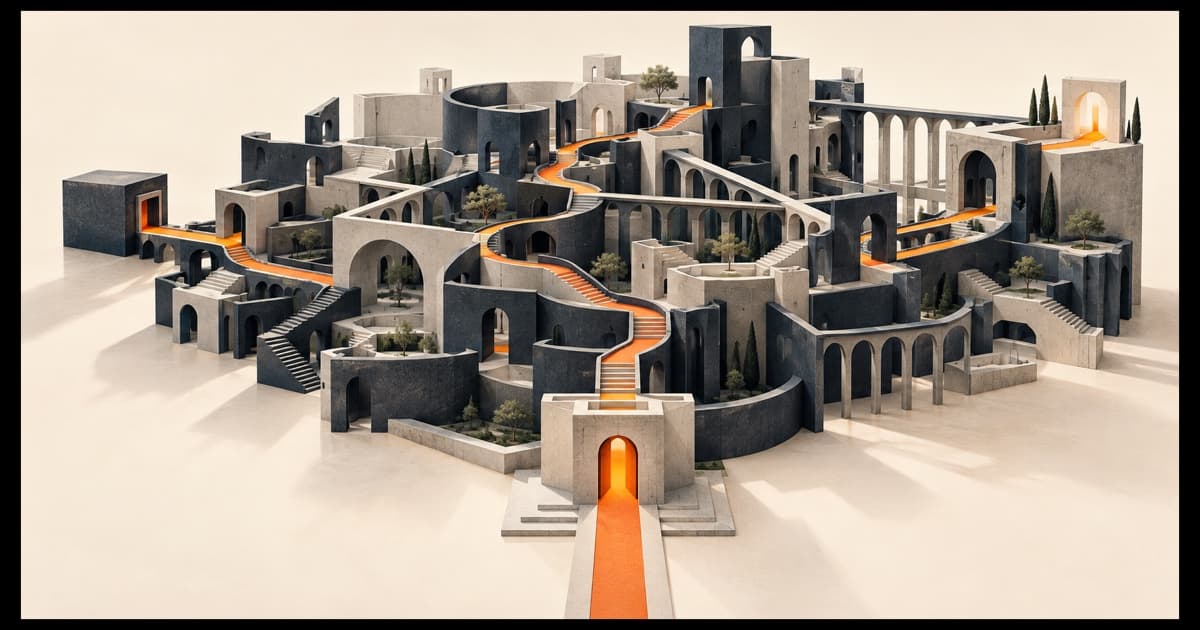
What makes the mind oversized
Connections. It moves between the visible event and the wider system around it.
Horizon. It pictures systems, institutions and futures beyond the immediate task.
A customer complaint may expose a product flaw, a training gap, the wrong incentive, weak pricing or a change in the market. A delayed payment may reveal friction in trust, regulation, infrastructure or access to capital. One observation opens several doors at once.
The mind then compares the problem with something read years ago, a pattern from another industry and an outcome that has yet to happen. This can expose a useful connection. It can also produce confident nonsense. Range generates possibilities. Evidence decides which ones are true.
What the range makes possible
Range helps you see structure beneath events. You become less interested in isolated failures and more interested in what keeps producing them. That instinct becomes useful when the obvious fix has failed or when the problem crosses product, people, capital and policy.
It also allows synthesis across disciplines. Software teaches observability. Finance reveals how incentives move behaviour. Distribution shows why a useful product without access still produces a poor outcome. History reminds us that many new problems have appeared in another form.
The longer horizon creates institutional imagination. You can see how a product might become a platform, how a task might become a system and how today's transaction might reveal tomorrow's infrastructure. Used well, that view helps today's decision leave room for growth.
What the range can damage
The first danger is complexity before evidence. The mind can see version twelve while reality still needs version one. You begin designing for scale that has not arrived and solving edge cases no customer has raised. Ambition becomes useful in sequence. Reality has to earn each layer.
The second is translation debt. Several connections arrive at once, making the conclusion feel obvious to you. Then you present that conclusion without the path. Seeing the path first still leaves you responsible for showing it. People need the reasoning before they can challenge, improve or build on the idea.
The third is the restless engine. A mind accustomed to difficult problems may turn a small setback into a strategic crisis, reopen a settled decision or manufacture tension simply to remain occupied.
Identity creates another trap. Small tasks begin to feel beneath the big thinker. Repetition feels dull. Finishing looks less interesting than imagining. Yet every significant thing I have helped build was carried by ordinary acts repeated properly. Calls returned. Numbers checked. Customers heard. Decisions documented. Work shipped.
The operating system it needs
An oversized mind needs hierarchy. Every idea may deserve consideration, but they cannot all receive attention at the same time.
Next. What could today's evidence unlock?
Later. What is worth preserving without pursuing yet?
This separates expansion from commitment. I widen the problem, write down the larger map and then close the doors. Once a decision has enough evidence, more possibilities only create delay.
Three questions bring me back. What are we trying to prove now? What is the current constraint? What is the smallest finished action that will give us better information?
I have also learned to translate twice. The first version is for me. It can contain the full landscape, every connection and the long horizon. The second is for the room. It must make the decision, the reasoning and the next action unmistakable.
Other people complete the system. Operators, customers, deadlines and numbers pull thought back towards reality. The right colleague can hear a ten-minute explanation and ask the question that restores proportion. What exactly are we doing by Friday?
Rest restores proportion too. Some open loops need sleep, prayer, exercise or an unhurried conversation. More analysis would only enlarge them.
I value the range this mind gives me. Restraint is what turns that range into useful work.
An oversized mind is not proven by how far it travels in private. It is proven by how clearly it returns, how responsibly it chooses and what it finishes.
Read next
Be Resilient About the Mission, Curious About the Method
The startup formula says master computer science, sharpen your business acumen, build operational excellence. I am grateful for all of it. But those are engine parts. They are not what keeps the machine moving when the road disappears.
8 min read→Systems Over Discipline
To achieve any meaningful goal, there must be a system deliberately designed to make it happen. When execution is left to feelings, motivation, or good intentions, progress becomes optional. And optional things rarely get done consistently.
4 min read→Work with me
If something in this piece resonated, that is usually where the conversation starts.
Written by
Tolu Adetuyi